Father Juan
Elena KnowsFather Juan is the priest of the church where Rita is found dead in the belfry. He helps bring her death to light, but initially puts the scheduled mass ahead of alerting the congregation; later, he insists that Rita took her own life and that Christian teaching settles the moral meaning of her death. His encounters with Elena show a more complicated tension: he offers practical assistance and recognizes her as a mother, yet his certainty about doctrine leaves little room for the questions she has come to ask.
Identity and Background
Father Juan has a longstanding connection to Rita and her family. A few weeks after Rita’s father died, he appealed to the board of the Catholic school to give the dead man’s daughter a position. Rita was only seventeen when she began working there. The evidence establishes this act of advocacy without describing their relationship beyond it; it nonetheless places Father Juan among the adults whose decisions shaped Rita’s early working life.
As a priest, he occupies both a practical role in the parish and an authoritative one in its religious life. He organizes the boys who help with church maintenance and assigns them to ring the bells before mass. He also understands the church as belonging to the community rather than to him alone, a distinction he stresses when Elena calls it his church. His language of communal belonging sits beside the authority he exercises over the building, its rites, and the timing of the response to Rita’s death.
Rita’s Discovery and the Mass
The Gómez boys discover Rita while carrying out their bell-ringing duties. They hurry down from the belfry to find Father Juan, who at first dismisses their alarm. When they insist, they lead him back upstairs. He recognizes Rita but does not speak her name. Instead, he takes the overturned chair from beneath her, stands on it, and checks her pulse. He then leads the boys back to the sacristy and calls the police.
Father Juan asks Inspector Avellaneda to wait until after the seven o’clock mass. Parishioners are already arriving, and he does not want the service canceled, particularly because it is the Thursday after Pentecost and the Solemnity of Corpus Christi. The inspector agrees that the congregation should not be told before the service. Father Juan tells the boys to stay in the sacristy and not speak about what they have seen, then puts on his vestments and proceeds with mass. His decision preserves the public religious schedule while the circumstances of Rita’s death remain undisclosed to those attending.
The separation between ceremony and investigation does not hold. During communion, the worn rope gives way and Rita falls onto the belfry floor. The congregation hears the sound, and the officers hurry upstairs. Father Juan completes the service, then directs the parishioners to leave and go home. When some press him for an explanation, he says that someone has died by suicide in the belfry but does not identify Rita. Once the church is empty, he goes up the tower. There he sees the coroner taking notes as officers photograph the scene, outline Rita’s position in chalk, and bag the rope as evidence. The evidence record thus presents him first as the person who confirms the death and summons the authorities, and then as a custodian of the service and its congregation.
Resistance to Elena’s Investigation
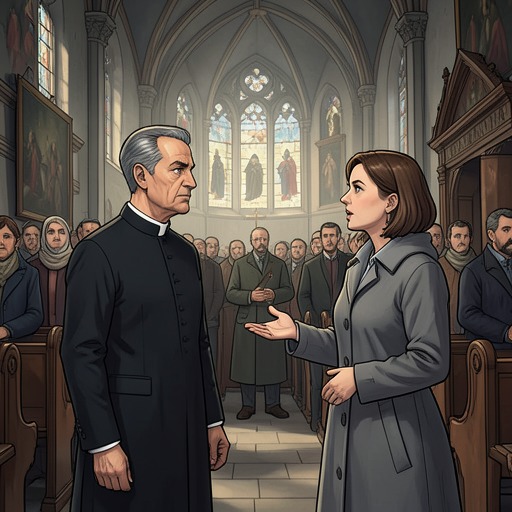
After Rita’s death, Father Juan is among the people least willing to speak with Inspector Avellaneda. Elena points out his repeated deflections and presses the inspector to pursue all possible explanations. When she visits the sacristy, Father Juan says he had been about to contact her: the school wants to hold a service for Rita during the Sunday seven o’clock mass, and he invites Elena to attend. She calculates that the time conflicts with her medication schedule, but nods. Their exchange immediately places ritual and bodily circumstance side by side: the service follows the parish calendar, while Elena’s day is organized around treatment.
Father Juan asks how she is managing her grief and urges her to make time to mourn. Elena says she will do so after she learns the whole truth and discovers who is responsible for how Rita came to be in the belfry. He answers that, in his view, the only remaining mystery is Rita’s reason for taking her own life, a reason she carried to her grave. When Elena points out that Rita avoided the church whenever rain threatened because she feared lightning, Father Juan says he had not known of that fear. He acknowledges that he saw Rita’s body, but offers no explanation for why she came to the church that day.
The disagreement is not simply about whether Rita died by suicide. Elena treats the rain and Rita’s lifelong avoidance of the church in stormy weather as facts that make the circumstances demand further inquiry. Father Juan treats her death as a known act whose motive is unknowable, and her insistence on the missing explanation as an unwillingness to accept it. The scene gives no evidence that he caused Rita’s death; it does show that he does not share Elena’s investigative premise and that his earlier reluctance to meet the inspector has intensified her suspicion.
Doctrine, the Body, and Motherhood
Father Juan interprets Elena’s distress through Christian teaching about the body. He explains that Christians believe the body belongs to God and that a person must not act against that divine ownership. He groups suicide with murder, abortion, and euthanasia as prohibited uses of a body that does not belong to its human occupant. In this framework, Rita’s death is an aberrant act to be met with pity, and Elena’s grief is something she should bring to faith and prayer.
Elena rejects the comfort and authority of that framework. She says she has not had the right to use her own body for some time, attributing that loss of bodily control to Parkinson’s disease rather than to God. When Father Juan urges calm and prayer, she insists that she wants judgment on earth: she wants his help uncovering the truth. He instead repeats his conclusion that Rita ended her own life and that the Christian prohibition makes the act wrong. Their exchange exposes a sharp contrast between his doctrinal account of bodily ownership and Elena’s lived experience of a body constrained by illness. He speaks in terms of divine authority; she insists on the authority of what has happened to her and on the need to investigate what happened to her daughter.
The encounter also tests what it means to call Elena a mother. As she struggles to rise and cross the sacristy threshold, Father Juan helps her despite her protests. At the door, he tells her that he forgets she is a mother. Elena challenges the category: she has a dead child, but no familiar social name for herself comparable to widow or orphan. She fears that a name supplied by the priest or his church could become a way of taking away her right to decide how she behaves, lives, or dies. Father Juan answers that she remains a mother. She does not accept his answer as resolution; she leaves with the certainty that she will not return.
Narrative Role and Ending
Father Juan’s role is defined by the distance between pastoral care and interpretive authority. He supports Rita’s employment, checks her pulse, summons the police, and helps Elena over a threshold she cannot manage alone. Yet in the crisis he protects the continuity of mass and withholds Rita’s identity from the congregation, while in conversation with Elena he treats the religious meaning of the death as more settled than its circumstances warrant for her. These actions do not make him a proven suspect; they make him an important obstacle to the kind of inquiry Elena is pursuing.
His final exchange with Elena leaves their disagreement unresolved. He offers the enduring identity of mother as reassurance, while she hears in imposed naming the possibility of control. Their parting is therefore more than a failed attempt at consolation: it marks the limit of Father Juan’s ability to meet Elena on her terms. He can help her cross the physical threshold, but he cannot persuade her to accept the religious account of Rita’s death or the identity he believes should sustain her.